Nano-Ceramic Film vs. Traditional Window Film: Which One Actually Saves You Money? The Data Reveals the Truth
2026/3/17

Search for "window film" on LinkedIn, and you'll find endless discussions about heat insulation and shatter resistance. But in an era where both businesses and consumers are watching every penny, a core question is often overlooked: Which film is the true money-saver?
If you think "saving money" simply means a lower initial price, you might end up paying a much higher price for that "savings" in the years to come. Today, let's peel back the marketing jargon and compare the true cost of Nano-Ceramic Film versus Traditional Window Film (especially metal films) using core principles and data.
1. The Essence of Insulation: Heat Absorption vs. Heat Reflection
Traditional Metal Films typically rely on reflection. Using magnetron sputtering, a layer of aluminum or silver is coated onto the base material, acting like a mirror to reflect heat away. This is highly effective initially.
However, the true test lies in durability.
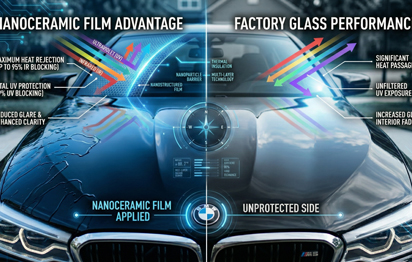
The core advantage of Nano-Ceramic Film lies in its low-absorption, high-dissipation mechanism. Instead of simply reflecting light (which can cause light pollution), ceramic nanoparticles (like Titanium Nitride) absorb infrared radiation and re-emit the heat through the glass.
Data Comparison:
High-quality nano-ceramic films can block 98% of infrared and 99% of UV rays. In building applications, energy-saving tests in the Nanjing region showed that applying nano-ceramic film resulted in air conditioning energy savings of over 30%, reducing indoor temperatures by 6-10°C in the summer.
In contrast, while ordinary metal films offer decent initial insulation, their metal layers are prone to oxidation. Over time, their thermal performance plummets. The so-called "savings" from the cheap film are soon lost to soaring electricity bills.
2. Hidden Costs: Signal Blocking and Driving Safety
For vehicle owners, "saving money" cannot come at the cost of convenience and safety.
The biggest drawback of ordinary metal films is signal blocking. Due to their metallic composition, they create a "Faraday cage" effect, leading to GPS signal attenuation, dropped calls, and even ETC reader failures. In the era of smart cars, this can even interfere with the sensors of autonomous driving systems.
Nano-Ceramic Film is a completely "transparent conductor." Since it contains no metal, it does not block electromagnetic signals at all. This means your navigation, 5G, and ETC all maintain full signal strength.
If a metal film causes you to miss a turn due to GPS drift, the cost of wasted time and the safety risk is a far greater expense than the film itself.
3. Lifecycle Cost: Frequent Replacement is the Real Expense
Many people opt for cheap, ordinary window films costing a few hundred dollars, forgetting to factor in lifespan.
Ordinary Metal/Dyed Film: Prone to oxidation, bubbling, and fading. Performance typically degrades after 2-3 years, requiring replacement in about 5 years.
Nano-Ceramic Film: Ceramic materials are chemically inert, corrosion-resistant, and non-oxidizing. High-quality products have an annual decay rate of only 0.2%, with a design life of over 20 years.
The Math:
With ordinary film (e.g., $100 initial cost), replacing it every 5 years means 4 replacements over 20 years. Total cost: $400 + the hassle of 4 installations.
With nano-ceramic film (e.g., $250 initial cost), no replacement is needed for 20 years. You save $150 in cash and avoid the multiple rounds of labor and waste.
Conclusion: Nano-Ceramic Film is a True "Asset," Not a "Consumable"
Whether for architectural glass or automotive glass, Nano-Ceramic Film—with its high clarity, zero signal blockage, and long lifespan—is replacing traditional metal films worldwide. It not only saves you money on air conditioning bills and replacement costs but also spares you the endless frustration caused by signal issues.
True savings come from looking at the total cost, not just the price tag.
Why Choose Anhui Julun? — A Practitioner of Cutting-Edge Nano-Ceramic Technology
Understanding the value of nano-ceramic film is one thing; choosing a reliable partner is another. Anhui Julun New Material Co., Ltd. stands at the forefront of this industry technology.
Our Core Advantages:
Choosing Anhui Julun means more than just buying a film; it means choosing an energy-saving philosophy based on long-termism. Let us use "Intelligent Manufacturing" nano-ceramic technology to protect every kilowatt-hour of electricity and every safe journey you take.
Contact us today to get your personalized savings plan.

Anhui Julun New Materials Technology Co., Ltd. All rights reservedDisclaimerAnhui ICP No. 2025083127
Technical support:Netnew Technology(www.ibw.cn)
Contact: Manager XieTel: 13321916539
Address: No. 18, Jinger Road, Quanjiao Economic Development Zone, Chuzhou, Anhui